5.2.5.4 Firmware & Software Architecture
This section documents the two-tier control architecture, the Teensy 4.0 firmware evolution, the strike library system, and the ROS 2 control interface.
Two-Tier Hierarchical Architecture
The control system follows a two-tier hierarchical design.
Tier 1 resides on the Jetson Orin NX running
ROS 2 Humble, which hosts the GUI
(unified_GUI_V3.py), publishes motor commands at
100 Hz, and performs all combat FSM decision-making, strike
sequencing, and impact detection.
Tier 2 resides on the Teensy 4.0 running micro-ROS, which executes a deterministic 200 Hz unified loop (5 ms period). Each cycle performs CAN motor control, I2C IMU polling, MDDS10 height PWM/DIR output, and publishes a 21-double feedback payload via micro-ROS.
Teensy 4.0 Firmware — 200 Hz Unified Loop
The Teensy 4.0 executes a deterministic 200 Hz unified loop
(5 ms period) integrating CAN motor control, I2C IMU polling, MDDS10 height
PWM/DIR, and micro-ROS publishing into a single cycle. The CAN motor
control layer employs sparse edge-triggering, in which commands are
sent only on position changes exceeding 0.01 rad or upon a 100 ms
keep-alive timeout, thereby preventing the Damiao internal trajectory
planner from resetting. The I2C subsystem polls four MPU6050 sensors
at 200 Hz across a dual-bus 400 kHz configuration, packing raw
3-axis acceleration data into the 21-double feedback payload. An
I2C hard-STOP protocol provides manual clock recovery (9 SCL toggles
followed by a STOP condition) for long-wire bus hang prevention.
Additionally, a micro-ROS disconnect recovery mechanism triggers a
SCB_AIRCR hardware reset when the transport heartbeat
is lost.
Feedback Payload Structure
The /motor_feedback topic carries a Float64MultiArray
of 21 doubles:
[pos×4, current×4, CAN_count, IMU_accel×12]
 ─────  ────────   ─────────  ──────────────
  0-3     4-7          8         9-20
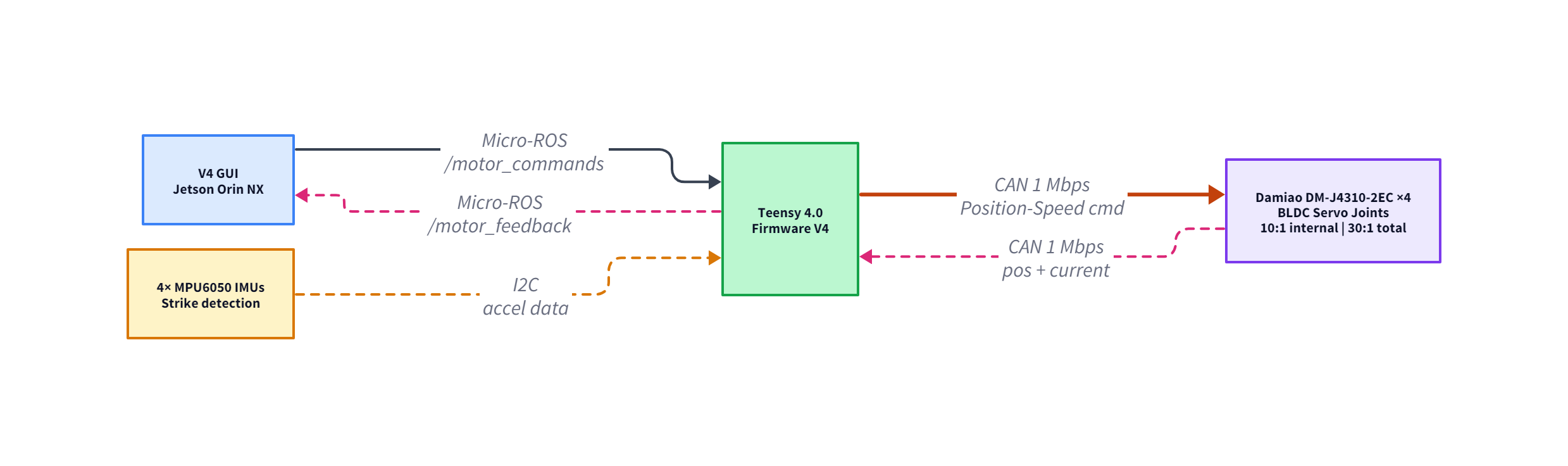 Arm actuation data and control architecture: command and feedback data flow between the Jetson Orin NX (ROS 2), Teensy 4.0 (micro-ROS), four Damiao DM-J4310-2EC motors via CAN bus, and four MPU6050 IMU sensors via I2C. Generated from D2 source.
Click to enlarge.
Arm actuation data and control architecture: command and feedback data flow between the Jetson Orin NX (ROS 2), Teensy 4.0 (micro-ROS), four Damiao DM-J4310-2EC motors via CAN bus, and four MPU6050 IMU sensors via I2C. Generated from D2 source.
Click to enlarge.
Kinematic Model
The coaxial differential joint couples Motor 1 (roll) and Motor 2 (pitch) through a 3:1 helical gear reduction into a shared bevel gear stack. Because the bevel gear walks when only the roll motor moves, pitch and roll are mechanically coupled and cannot be commanded independently without software decoupling.
Before deployment, a three-step Homing Wizard calibrates the digital twin to the
physical hardware. (1) Set Roll Zero — the operator positions the arm
at neutral and captures \(o_r\). (2) Run Pitch Scan — the software
drives the pitch motor automatically in 0.05 rad steps until motor current
exceeds a configurable threshold (default 0.3 A), discovering the physical
pitch limits. (3) Calibrate Directions — the GUI commands short
test movements and presents binary prompts (e.g. "did the arm swing FORWARD?"),
from which \(s_r\), \(s_p\), and \(c\) are resolved. The resulting constants are
persisted to data/arm_config.yaml, grounding all FK and IK calculations
to the specific build's tolerances.
Forward Kinematics — Motor Space → Joint Space
The calibrated forward kinematics resolve the bevel coupling by incorporating the home offsets and sign parameters:
$$\theta_{\text{roll}} = s_r \cdot \frac{m_r - o_r}{G} \tag{Eq. 1}$$ $$\theta_{\text{pitch}} = s_p \cdot \frac{(m_p - o_p)\; +\; c\,(m_r - o_r)}{G} \tag{Eq. 2}$$where \(G = 3\) (helical gear reduction). Eq. 2 exposes the differential coupling: pitch depends on the sum of the pitch motor displacement and a coupling-weighted roll motor displacement.
Cartesian Projection — Joint Space → Arm-Tip Direction
The joint angles are projected into a normalised Cartesian arm-tip direction vector using the Rotation-Around-Arm-Axis model. At \(\theta_{\text{pitch}} = 0\) the arm points straight outward along the X-axis; pitching the arm sweeps a circle in the Y–Z plane whose orientation is governed by the roll angle:
$$d_x = s_x \cdot \cos(\theta_{\text{pitch}}) \tag{Eq. 3}$$ $$d_y = \sin(\theta_{\text{pitch}}) \cdot \cos(\theta_{\text{roll}}) \tag{Eq. 4}$$ $$d_z = \sin(\theta_{\text{pitch}}) \cdot \sin(\theta_{\text{roll}}) \tag{Eq. 5}$$where \(s_x = -1\) (left arm) or \(+1\) (right arm).
This Cartesian representation forms the software digital twin of permissible arm configurations. Every incoming motor-space target is converted to joint space in Python, validated, and — if necessary — clamped before any CAN command is issued to the Teensy 4.0. Pitch is constrained to a software operating zone of ±1.0 rad (physical hard-stop limit: ±1.57 rad). Applying the clamp in joint space rather than as independent per-motor bounds eliminates the Jump-Back defect, where hardware-side endstops issued sudden counter-commands to an uncommanded motor.
Inverse Kinematics — Joint Space → Motor Space
To command a desired joint-space pose, the inverse kinematics convert back to raw motor positions and apply the software decoupling term that cancels the bevel walking effect in real-time:
$$\Delta_r = \left(\frac{\theta_{\text{roll}}}{s_r}\right) \cdot G, \qquad m_r = \Delta_r + o_r \tag{Eq. 6}$$ $$m_p = \left[\left(\frac{\theta_{\text{pitch}}}{s_p}\right) \cdot G \;-\; c\,\Delta_r\right] + o_p \tag{Eq. 7}$$arm_config.yaml.
Strike Library
Each strike is defined by a Windup position and an Apex (impact) position, both stored in joint space so that entries survive recalibration. Strikes are authored interactively in the 3D digital twin: an azimuth slider selects one of 30 pre-computed workspace arcs rendered against the calibrated arm model; clicking the arc places Windup and Apex markers. A quadratic Bézier path is drawn in real-time (green = within calibrated limits, red = out of limits). Curvature and arc-angle sliders shape the trajectory before saving. Libraries are persisted as JSON:
{
  "left":  { "Jab": {"space": "joint", "windup": [roll, pitch],
                      "apex": [roll, pitch], "curvature": 0.0,
                      "arc_angle": 0.0, "waypoints": [...]} },
  "right": { "Cross": { ... } }
}
State-Space Strike Planning
The Cartesian arm-tip vector produced by the kinematic model drives three planning behaviours in the Dynamic Sparring FSM. Vector alignment skip logic computes the dot-product angle between a strike's intended direction and the current approach vector; if below 30°, the Windup node is bypassed for a more fluid transition. Perimeter orbit transit routing inserts ordered library Windup positions as via-points when a direct inter-strike transit would cross the user-facing centre-line, keeping the arm on a safe perimeter path. Synchronised per-motor speed scaling proportionally adjusts each motor's speed to its share of the total travel distance, producing straight-line motor-space trajectories between any two positions.
ROS Control Interface
A dedicated ROS Control Tab enables external front-end integration via 7 ROS 2 topics:
Subscriber Topics (Front-End → Robot)
| Topic | Function |
|---|---|
/robot/strike_command | Execute strike by slot + duration |
/robot/punch_slots | Assign strikes to numbered slots |
/robot/system_enable | Arm or disarm motors |
/robot/imu_calibration_cmd | Trigger IMU calibration |
Publisher Topics (Robot → Front-End)
| Topic | Function |
|---|---|
/robot/strike_feedback | Strike completion status + timing |
/robot/imu_calibration_status | Calibration progress + results |
/robot/strike_detected | Real-time pad strike events |